Board Member Recruiting: How to Source and Place Directors in 2026
Board searches are the highest-fee, highest-relationship engagements in executive search. They're also the least understood by recruiters who haven't done one. Here's what the data shows about how board placements work.
Board member recruiting operates by different rules than executive hiring. The candidate isn't leaving a job. The compensation isn't primarily cash. The "interview" is a series of dinners and phone calls. And the relationship between the search firm and the nominating committee is the single most important factor in winning the engagement.
Yet the demand for board search is growing faster than the supply of firms that do it well. Governance requirements are expanding. Institutional investors are demanding board refreshment. And the push for diverse boards has opened seats that would have gone to the same recycled names five years ago.
For executive search firms looking to move upmarket, board recruiting is the highest-margin, most defensible practice area. Here's how the market works in 2026.
The Market: Board Seat Demand in 2026
Board turnover is at a 15-year high. Three forces are driving it.
Force 1: Age and tenure limits. More companies are adopting mandatory retirement ages (typically 72-75) and tenure limits (typically 10-15 years) for board members. These policies are creating a steady stream of open seats that didn't exist a decade ago. The Russell 3000 saw a 40% increase in director retirements between 2020 and 2025.
Force 2: Skills gap pressure. Boards that were built for a pre-digital, pre-AI world don't have the expertise to oversee companies navigating those transitions. Cybersecurity, artificial intelligence, digital transformation, ESG reporting. These are competencies that most legacy board members lack. Companies are adding new seats or replacing retiring directors with candidates who bring these skills.
Force 3: Diversity mandates. Institutional investors, proxy advisory firms (ISS, Glass Lewis), and state regulations (California, Washington, Illinois) all push for board diversity. Whether measured by gender, race, age, or professional background, the expectation is clear: boards should reflect the markets they serve. This has expanded the candidate pool beyond the traditional "retired CEO" pipeline and created opportunities for search firms with diverse networks.
Compensation: What Board Members Earn
Board compensation structures differ dramatically between public companies, private companies, and nonprofits. Recruiters who conflate these structures lose credibility with candidates.
Public Company Boards
The median total compensation for an independent director at an S&P 500 company is $310K per year. This breaks down as:
- Cash retainer: $100K-$120K per year
- Equity grant: $175K-$225K per year (typically RSUs vesting over 1 year)
- Committee chair premiums: $15K-$35K additional for audit, compensation, or nominating committee chairs
- Lead independent director premium: $25K-$40K additional
Mid-cap public companies (S&P 400) pay roughly 20% less. Small-cap public companies pay 40-50% less but are adding equity to close the gap. The total time commitment is 200-250 hours per year: four to six board meetings, committee meetings, preparation time, and ad hoc calls with management.
Private Company Boards (Venture-Backed)
Private company board compensation is less standardized and more variable. The typical structure for a venture-backed company:
- Cash retainer: $25K-$75K per year (some early-stage companies pay nothing in cash)
- Equity grant: 0.1-0.25% of the company, vesting over 2-4 years
- Observer seats: No compensation (investor representatives)
The equity component is the draw for private company boards. A 0.15% grant in a Series C company valued at $500M is worth $750K on paper. If the company goes public or is acquired at a premium, that number grows. This is why experienced board members accept lower cash compensation for private company seats: the upside potential is significant.
Nonprofit Boards
Most nonprofit board positions are unpaid. Large foundations and health systems may offer stipends of $5K-$15K per year. The compensation is reputational: board membership at a prestigious nonprofit signals community standing and broadens a professional network. For recruiters, nonprofit board placements generate goodwill that leads to paid executive search work from the same organization.
The Search Process: How Board Engagements Work
Board searches follow a distinct process that shares some DNA with executive search but has critical differences.
Phase 1: Specification Development (Week 1-3)
The nominating and governance committee defines the board's needs. This isn't a job description. It's a skills matrix. The committee identifies which competencies the current board lacks, which perspectives are missing, and what the company's strategic direction requires in the next 3-5 years.
The search firm's value in this phase is pattern recognition. "Based on the 40 board searches we've run for companies at your stage, the competency gap you should prioritize is X, not Y." This consultative input is what justifies the retained fee. It's also what internal HR teams cannot provide because they don't have the cross-company view.
Phase 2: Candidate Identification (Week 3-6)
Board candidate sourcing is fundamentally different from executive sourcing. LinkedIn InMail doesn't work. These candidates are sitting CEOs, retired executives, or active board members. They receive dozens of board inquiries per year. They respond to people they know, not strangers in their inbox.
The three sourcing channels that produce results:
- Firm's existing relationships (50% of placements). The senior partner calls a candidate they placed in a CEO role five years ago and says, "I have a board opportunity that fits your profile." The candidate takes the call because the relationship exists. This is why board search is concentrated among a small number of firms: the relationships compound over decades.
- Board network referrals (35% of placements). Current board members recommend candidates from their own networks. The search firm's job is to expand beyond the "usual suspects" by probing the committee's second and third-degree connections. "Who's the best CFO you've worked with who's not already on three boards?"
- Governance organizations (15% of placements). NACD (National Association of Corporate Directors), theBoardlist, and similar organizations maintain databases of board-ready executives. These are particularly useful for diversity-focused searches and for identifying first-time board candidates who aren't yet in the traditional networks.
Phase 3: Assessment and Cultivation (Week 6-12)
Board candidates don't "interview" in the traditional sense. They have conversations. The nominating committee chair meets the candidate for dinner. The CEO has a one-on-one call. Other board members schedule informal check-ins. The process is relational, not transactional.
The search firm manages this process like a political campaign. They prep the candidate on each board member's priorities. They debrief after every interaction. They flag concerns early and address them before they become objections. The firm's project management is often the difference between a smooth 12-week process and a 6-month ordeal.
Due diligence for board candidates is more extensive than for executive hires. Background checks cover legal history, public statements, social media, and potential conflicts of interest. At public companies, the SEC requires disclosure of board member backgrounds. One missed conflict can derail the appointment and embarrass the nominating committee.
Phase 4: Appointment and Onboarding (Week 12-16)
Board appointments require a formal vote by the existing board. At public companies, the appointment may also require shareholder approval at the next annual meeting. The search firm's work continues through onboarding: scheduling introductions with management, providing background materials, and ensuring the new director is prepared for their first board meeting.
The Fee Structure
Board search fees are structured differently than executive search fees. The standard retained model applies, but the economics are distinct.
Public company board searches: $150K-$250K flat fee (not percentage-based, since board compensation is lower than C-suite compensation). The fee reflects the relationship value and the 3-4 month engagement timeline.
Private company board searches: $80K-$150K flat fee. Some firms accept equity or a combination of cash and equity for early-stage companies.
Nonprofit board searches: $30K-$60K, often discounted from the firm's standard rates. Some firms do one pro-bono nonprofit board search per year as a business development investment.
The margin on board searches is the highest in executive search because the work is relationship-intensive rather than volume-intensive. One senior partner can run three to four board searches simultaneously. The same partner might run one or two C-suite searches in the same period due to higher sourcing volume.
Breaking In: How to Build a Board Practice
For search firms without an existing board practice, the entry path is specific. You don't win board searches by marketing them. You win them by building relationships that lead to introductions.
Start with your C-suite placements. Every executive you place is a potential board candidate in 5-10 years. Maintain those relationships. When they're ready for board service, they'll remember the firm that placed them in their first CEO role.
Use nonprofit boards. Nonprofit board searches are smaller and less competitive. They're the training ground for board search methodology. And the board members you recruit for nonprofits often sit on corporate boards too. The relationship crosses over.
Develop industry-specific board expertise. Generalist board search is dominated by the Big Five firms (Spencer Stuart, Heidrick, Korn Ferry, Russell Reynolds, Egon Zehnder). The opportunity for smaller firms is in industry verticals: healthcare board governance, fintech board composition, energy transition board needs. Specialization is the competitive moat.
Explore industry-specific executive data to identify which sectors have the highest board turnover, or browse role intelligence to understand C-suite pipelines that feed into board candidacy.
Track the executive pipeline that feeds board candidacy
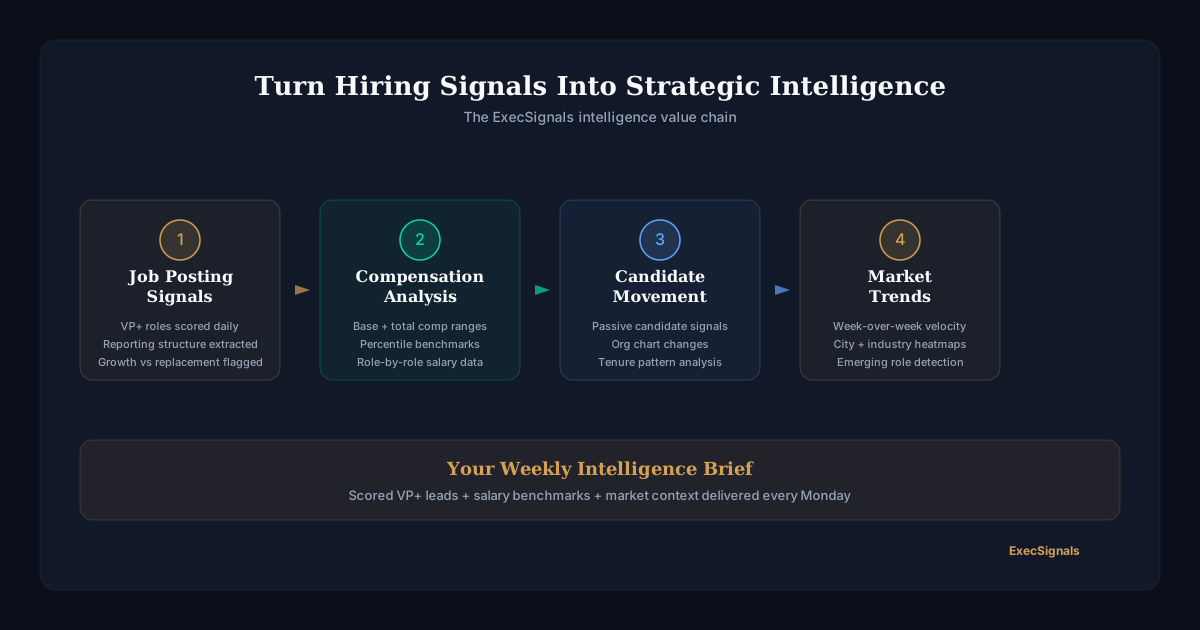
ExecSignals delivers scored VP+ leads weekly. Today's C-suite hire is tomorrow's board candidate. Start building the relationship now.
Send Me the Brief