CFO Roles in Private Equity Portfolio Companies: What Recruiters Should Know
Private equity firms replace the CFO in 60-70% of their portfolio companies within the first year of ownership. That creates a large, recurring, and highly specific search market that most recruiters underserve.
The PE-backed CFO is not the same role as a CFO at a public company or a venture-backed startup. The mandate is different. The timeline is compressed. The reporting relationships are layered. And the compensation structure, with management equity tied to exit multiples, changes the entire economics of the placement.
For executive search firms, PE portco CFO work is among the most lucrative specializations available. Here's how the market works and what recruiters need to know to serve it.
Why PE Firms Replace CFOs So Often
The 60-70% replacement rate isn't random. It reflects a fundamental mismatch between what the previous owner needed and what the PE firm needs.
Pre-acquisition CFOs are often controllers in disguise. At founder-led or family-owned businesses (the bread and butter of middle-market PE), the "CFO" frequently manages bookkeeping, tax compliance, and basic financial reporting. They've never built a 13-week cash flow forecast. They've never managed a credit facility with financial covenants. They've never presented to a PE board that expects granular monthly operating metrics.
The value creation mandate requires a different skill set. PE firms buy companies to improve them and sell them at a higher multiple. The CFO is the primary instrument of that value creation on the financial side. They identify margin improvement opportunities, optimize working capital, restructure debt, and build the financial story that supports the exit multiple. This is not a "keep the books clean" job.
The reporting cadence is intense. PE-backed CFOs report to both the company CEO and the PE firm's operating partner (or deal partner). Monthly board packages, quarterly investor updates, weekly cash flow reports, and ad hoc analysis requests are standard. CFOs who thrived in a quarterly reporting rhythm at a private company struggle with this pace.
The Three Types of PE CFO Searches
Not all PE CFO searches are the same. Understanding the three types helps recruiters match candidates correctly.
Type 1: Post-Acquisition Replacement (60% of searches)
The PE firm closes the deal, assesses the existing CFO, and decides to upgrade. This search typically launches 30-90 days after closing and needs to be completed within 60-90 days. Urgency is high. The PE firm is operating with an interim solution (often the outgoing CFO on a transition agreement or a fractional CFO from their network).
Type 2: Growth-Stage Upgrade (25% of searches)
The portfolio company has grown under PE ownership, and the CFO who was right at $50M revenue isn't right at $150M. This is a more deliberate search with a 90-120 day timeline. The existing CFO may move to a VP Finance role or exit with a positive reference. These searches are less urgent but more specific because the PE firm knows exactly which capabilities they're adding.
Type 3: Pre-Exit CFO (15% of searches)
The PE firm is 12-18 months from exit (sale to another PE firm, strategic acquisition, or IPO). They need a CFO who has prepared a company for sale or public offering before. This is the most senior and highest-compensated CFO search in the PE world. Candidates with prior exit experience command a 20-30% premium. The timeline is tight because every month without the right CFO delays exit preparation.
Compensation: How PE CFO Packages Work
PE-backed CFO compensation has three components, and the third one is what makes these placements uniquely valuable.
Base salary: $300K-$450K. Lower-middle-market PE companies ($50M-$200M revenue) pay the lower end. Upper-middle-market ($200M-$1B revenue) pays the higher end. These bases are comparable to public company CFO salaries at similar revenue levels.
Annual bonus: 30-50% of base. Tied to EBITDA targets, cash generation metrics, or a combination. The PE firm sets the targets during the annual planning process. Bonuses are real (not "up to"), with most PE-backed CFOs hitting 80-120% of target.
Management equity: 1-3% of the equity pool. This is the differentiator. PE firms allocate 10-15% of the company's equity to the management team. The CFO typically receives 1-3% of that pool (so 0.1-0.45% of the total company). This equity vests over the hold period and pays out at exit.
The math works like this: a PE firm buys a company for $200M, creates value to sell it for $400M. The CFO's 2% of the management pool (which is 12% of total equity) means 0.24% of the company. At a $400M exit, that's $960K before waterfall provisions. In a strong exit with multiple expansion plus EBITDA growth, the payout can reach $2M-$5M.
Recruiters who can explain this comp structure clearly to candidates have a significant advantage. Many strong CFO candidates from public companies or venture-backed startups don't understand PE management equity and undervalue the opportunity.
The Candidate Profile
PE firms have a specific template for the CFO they want. Deviation from this template requires a compelling reason.
Prior PE experience is strongly preferred. A CFO who has worked in one PE-backed company can start contributing immediately. They know the reporting cadence, the board dynamics, the operating partner relationship, and the exit preparation process. First-time PE CFOs take 3-6 months to acclimate. PE firms operating on a 4-5 year hold period don't want to spend 10% of that on ramp time.
Industry expertise matters more than you think. PE firms buy in verticals. A healthcare-focused PE firm (Welsh Carson, TPG, Bain Capital) wants a CFO who understands healthcare revenue cycles, reimbursement models, and regulatory dynamics. An industrial PE firm (Clayton Dubilier, Advent) wants a CFO who understands manufacturing margins, supply chain finance, and capex planning. The industry context is non-negotiable for most PE firms.
Big Four experience is a plus, not a requirement. Many PE-backed CFOs started their careers at Deloitte, PwC, EY, or KPMG. The audit and transaction advisory experience provides a strong foundation. But PE firms care more about what the candidate did as a CFO than where they started. A candidate with three years at KPMG followed by two PE-backed CFO tours is far more attractive than a candidate with 15 years at PwC and no operating experience.
The personality filter is real. PE-backed CFOs need to manage two principals: the CEO and the PE firm's operating partner. These two don't always agree. The CFO must be diplomatic enough to navigate disagreements while being direct enough to deliver bad news. PE operating partners describe the ideal as "collaborative but not a pushover." Screen for this in references.
Building a PE CFO Practice
For recruiters, the PE CFO market has two attractive qualities: it's recurring and it's relationship-driven.
Recurring: A PE firm with 20 portfolio companies will replace 12-14 CFOs within the first year of ownership. If they deploy 3-4 new deals per year, that's 2-3 CFO searches annually from a single PE client. Multiply by the number of PE firms in your network and the pipeline is substantial.
Relationship-driven: PE operating partners work with recruiters they trust. They don't post on LinkedIn and wait for applications. They call their preferred search partner and say "I need a CFO for the new platform company we just closed." Winning that first engagement is the hard part. Once you're in, the repeat business flows.
Start by mapping the PE firms in your geography. Identify the operating partners (not the deal partners; operating partners own talent). Offer industry-specific compensation benchmarking as a foot-in-the-door service. PE firms constantly need to know "what should we pay a CFO at a $75M healthcare services company in Chicago?" Be the person who answers that question with data, and the search engagement follows.
The SBA's investment capital data tracks PE deal activity that creates CFO demand. When PE acquisitions spike in a sector, CFO searches follow 60-90 days later. Monitoring deal flow alongside hiring signals gives you the earliest possible warning of upcoming searches. AICPA certification requirements and financial reporting standards are useful screening criteria when evaluating PE CFO candidates.
Build a list of the 20 most active PE firms in your coverage area. Track their portfolio company acquisitions monthly. When they close a new deal, the CFO search is coming. Being first to that conversation is often the difference between winning a retained engagement and competing in a contingency bake-off. PitchBook and Preqin are the standard tools for tracking PE deal flow, but you can also monitor press releases through Google Alerts set for key PE firm names plus "acquisition" or "platform company."
Check financial services industry data and CFO role intelligence for additional benchmarking context.
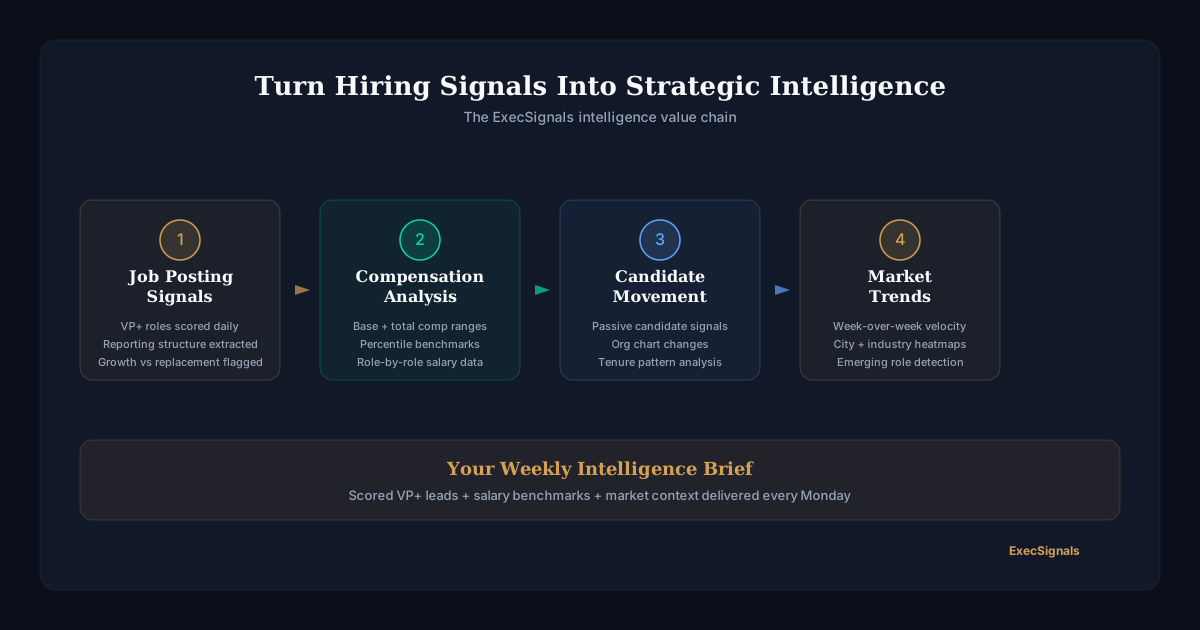
Track CFO hiring signals across PE portcos
ExecSignals scores VP+ roles including CFO searches at PE-backed companies every week. Your first week is free.
Send Me the Brief