Executive Compensation Trends Q2 2026
Compensation is the recruiter's currency. You need to know the numbers cold: base ranges, bonus targets, equity structures, and how they all move quarter to quarter. Here are the Q2 2026 benchmarks for VP+ roles across every major function.
Executive compensation increased 4.2% year-over-year at the VP+ level through Q1 2026, outpacing the 3.1% increase for all professional roles. But the growth is not uniform. Base salaries are up. Equity grants are flat to slightly down. Bonus structures are shifting from discretionary to formulaic. And salary transparency legislation in 14 states is compressing the spread between what companies want to pay and what candidates expect.
This quarterly report covers the comp data executive recruiters need for placement conversations, client advisory, and fee calculations.
VP-Level Compensation (All Functions)
The VP tier is the largest executive hiring segment and the most common entry point for retained search engagements. Here are the Q2 2026 benchmarks:
- Base salary: $275K-$325K median. 25th percentile: $235K. 75th percentile: $380K.
- Target bonus: 30-40% of base. Actual bonus payouts averaged 92% of target in 2025.
- Equity (venture-backed): 0.15%-0.40% of fully diluted shares, vesting over 4 years.
- Equity (public company): $150K-$400K annual RSU grant value.
- Total compensation: $380K-$550K median, with top-quartile packages exceeding $650K.
Notable function-specific variances within the VP tier:
- VP Engineering/Product (tech): $320K-$420K base, $550K-$850K total comp. Premium driven by equity.
- VP Sales: $260K-$340K base plus $180K-$300K variable. OTE of $440K-$640K.
- VP Marketing: $250K-$320K base, $380K-$520K total comp.
- VP Finance: $260K-$330K base, $390K-$510K total comp.
- VP People/HR: $240K-$300K base, $350K-$460K total comp.
C-Suite Compensation
C-suite compensation varies dramatically by company size, stage, and industry. These ranges reflect mid-market to large companies ($100M+ revenue):
- CEO: $450K-$750K base. $800K-$2M+ total comp. Equity: 1-3% at venture-backed, $1M-$5M+ annual grant at public.
- CRO/Chief Revenue Officer: $320K-$420K base. $450K-$750K total comp. Variable comp is 40-60% of base.
- CFO: $310K-$400K base. $420K-$680K total comp. Equity is increasingly performance-weighted.
- CTO: $300K-$400K base. $400K-$650K total comp. Highest equity grant of any non-CEO role at tech companies.
- CMO: $280K-$370K base. $380K-$580K total comp. CMO tenure remains the shortest of any C-suite role at 3.3 years.
- CHRO: $270K-$350K base. $350K-$520K total comp. Growing rapidly as talent strategy gains board attention.
- CISO: $300K-$380K base. $400K-$520K total comp. Shortage-driven premium of 15-20% over comparable tech roles.
Equity Trends
The equity landscape is shifting in three ways that directly impact executive search:
Performance-based vesting is expanding. 42% of new executive equity grants include performance conditions, up from 28% in 2024. Common performance metrics include revenue targets, EBITDA thresholds, and total shareholder return. Time-based vesting alone is becoming a mid-level benefit; executives are increasingly expected to earn their equity.
RSUs have overtaken options. RSUs represent 68% of VP+ equity grants, up from 55% in 2022. Stock options represent 22%, with the remainder in performance shares and other vehicles. The shift reflects executive preference for compensation with guaranteed value (RSUs) over instruments that require stock price appreciation (options). For early-stage companies, options remain dominant because the equity budget is larger and the growth potential justifies the risk.
Refresh grants are larger but less frequent. Companies are moving from annual equity refreshes to biennial grants of larger size. A VP who previously received $200K in RSUs annually might now receive $450K every two years. The logic is retention: a large biennial grant creates a stronger retention hook because the unvested amount is always significant.
For recruiter conversations, the equity component often determines whether a candidate accepts an offer. A candidate at a FAANG company with $500K in unvested RSUs will not move for a base salary increase alone. You need to quantify what they are leaving on the table and present an equity package that makes them whole or presents a compelling upside scenario. Our compensation negotiation data provides the framework.
Bonus Structures
Executive bonus structures are becoming more formulaic and transparent. The days of purely discretionary bonuses at the VP+ level are declining because candidates demand clarity on earning potential and boards demand accountability for incentive payouts.
Common bonus structures in Q2 2026:
- Revenue-linked (CRO, VP Sales): 40-60% of base salary at target. Accelerators above quota can push actual bonus to 80-120% of base. Typical quota attainment is 85-95% of target.
- Performance-rated (CFO, CHRO, CMO): 30-40% of base at target. Payout is a function of company performance (60%) and individual objectives (40%). Median actual payout is 90-95% of target.
- Hybrid (CEO): 50-100% of base at target. Weighted across financial metrics (70%), strategic objectives (20%), and board evaluation (10%). CEO bonus volatility is higher than other C-suite roles.
Industry Compensation Variances
The industry a company operates in has a larger impact on executive compensation than most other factors. Here are the industry-specific multipliers relative to the all-industry median:
- Technology (software, SaaS): 1.25x-1.45x. Highest base and equity. VP Engineering at a growth-stage SaaS company can exceed $700K total comp.
- Financial services (banking, fintech): 1.20x-1.35x. High base and bonus. Equity less prominent except at fintechs.
- Healthcare (health systems, biotech): 1.00x-1.15x. Base at market. Bonus and equity below tech. CNO and CMO roles carry a 10-15% premium over comparable non-clinical executive roles.
- Manufacturing/industrial: 0.90x-1.05x. Base slightly below market. Bonus structures are more conservative.
- Nonprofit: 0.65x-0.80x. Significantly below market on all components. Offset by mission alignment and, in healthcare nonprofits, strong benefits packages.
Impact of Salary Transparency Laws
Salary transparency legislation now covers 14 states and several major cities, including New York, California, Colorado, and Washington. The impact on VP+ compensation is measurable:
Compensation ranges are narrowing. The spread between the low and high end of posted salary ranges for VP+ roles has compressed by 15% since transparency laws took effect. Companies that previously posted ranges like "$200K-$400K" (a 100% spread) are now posting "$280K-$380K" (a 36% spread). Narrower ranges give candidates more useful information and reduce the anchoring effects that historically disadvantaged less experienced negotiators.
Offer acceptance rates are up. VP+ roles with posted salary ranges have a 12% higher offer acceptance rate than roles without. Candidates self-select based on the range, reducing the frequency of offers that are rejected on compensation alone.
Geographic pay differentials are shrinking. Remote-eligible VP roles with posted ranges show a smaller geographic compensation differential than roles without. The transparency makes it harder for companies to justify a 20% discount for a VP working from Austin instead of San Francisco when the posted range is the same for both locations.
What This Means for Recruiters
These compensation trends have direct implications for search practice:
Know the equity math. Candidates and clients both expect their recruiter to understand equity valuation, vesting schedules, and the tax implications of different equity vehicles. If you cannot explain the difference between an ISO and an RSU, you are losing credibility in comp conversations. Build a simple equity valuation model and use it in every placement discussion.
Lead with total comp, not base. The candidate who focuses only on base salary is leaving money on the table. The recruiter who presents only base salary is leaving fees on the table. Frame every conversation around total compensation: base + bonus + equity + benefits. A 33% fee on $600K total comp produces a very different engagement value than 33% on a $300K base.
Use transparency data as leverage. In states with salary transparency laws, the posted ranges are public data. Use them. "Your competitor posted this VP Sales role at $290K-$360K. Your offer at $260K is below market" is a data-backed negotiation tactic that helps both the candidate and the search outcome.
Sign-On Bonuses and Retention Packages
Sign-on bonuses at the VP+ level are becoming more common as companies compete for scarce talent. In Q1 2026, 38% of VP+ offers included a sign-on bonus, up from 28% in 2024. Median sign-on bonus: $75K-$150K for VP-level roles and $100K-$250K for C-suite. Sign-on bonuses are used primarily to offset unvested equity the candidate forfeits by leaving their current employer.
Retention packages are the employer's counter to poaching. Companies are proactively offering retention bonuses of $50K-$200K (vesting over 12-24 months) to high-flight-risk executives. This is one driver behind the rising counter-offer acceptance rates. The recruiter who understands a candidate's unvested compensation position can better advise on what the hiring company needs to offer to make the candidate whole.
Get VP+ compensation data every Monday
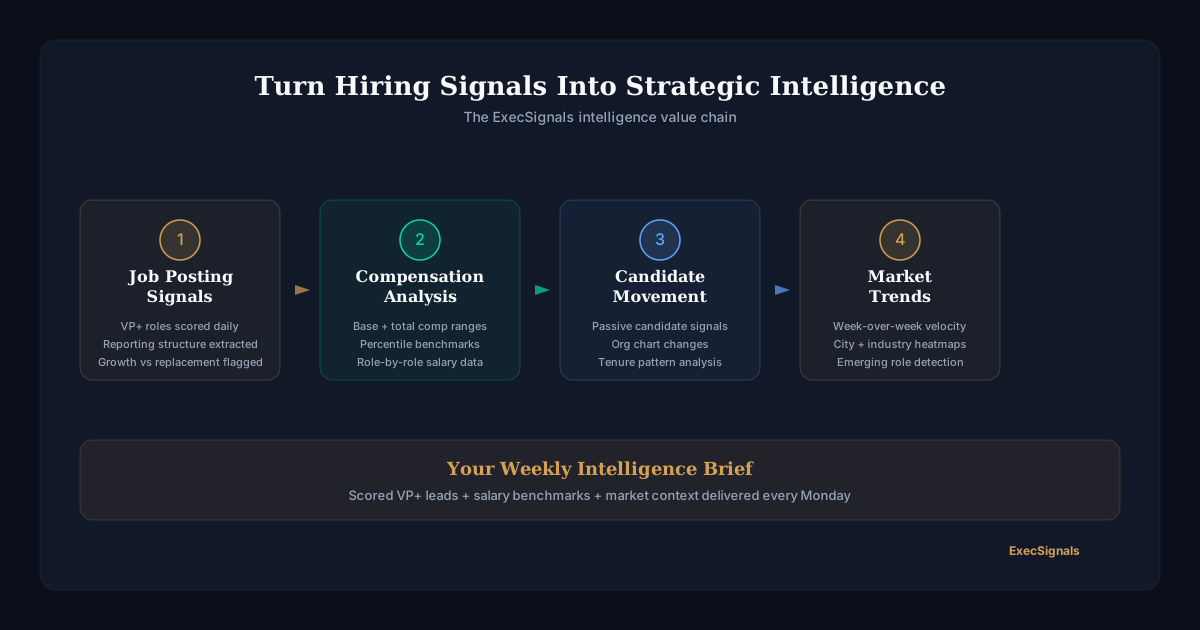
ExecSignals delivers salary benchmarks with every scored executive lead. Your first week is free.
Send Me the Brief