Executive Hiring Signals: How to Spot Companies About to Hire a CRO
The CRO role doesn't appear out of nowhere. There's a pattern. Recruiters who learn to read it are pitching retained searches while everyone else is still refreshing LinkedIn.
Every week, ExecSignals scores hundreds of VP+ roles. And the most interesting ones aren't always the CRO postings themselves. They're the roles that show up 60 to 90 days before the CRO search goes live.
We've tracked this pattern across thousands of executive postings. The data points to five reliable signals that a company is building toward a Chief Revenue Officer hire. If you're in retained search, these signals are your early-warning system.
Signal 1: VP Sales Reports Directly to the CEO
This is the single strongest predictor. When a company posts a VP Sales role that reports to the CEO, with no CRO in the org chart, they're telling you something important: the revenue function doesn't have a dedicated executive yet.
That VP Sales hire is often a stopgap. The company needs revenue leadership now, but the board wants the CRO to be a more senior, strategic hire. They'll bring on the VP Sales first, prove out the sales motion, then layer a CRO on top.
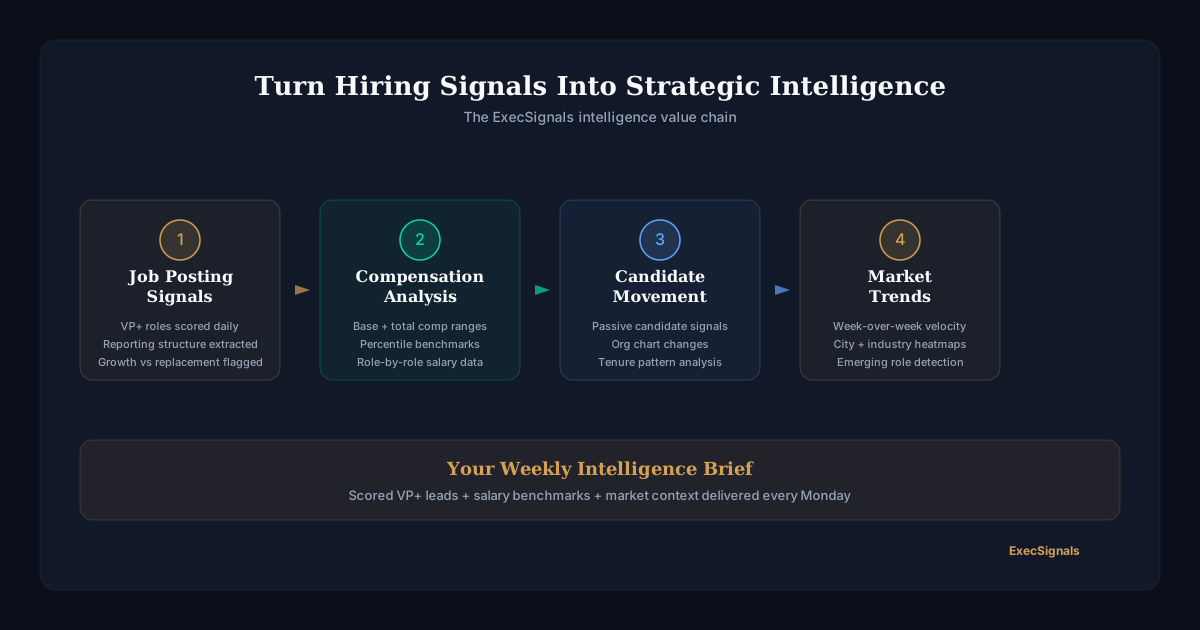
The reporting structure is the key detail. A VP Sales reporting to an existing CRO is a backfill or expansion. A VP Sales reporting to the CEO is a gap waiting to be filled. ExecSignals extracts this signal automatically from every job description, which is exactly the kind of context that salary benchmarks alone can't give you.
Signal 2: Multiple Sales Leadership Hires in a 90-Day Window
One VP Sales posting is a hire. Three sales leadership postings in 90 days is a strategy. When you see a company hiring a VP Sales, a Director of Sales Ops, and a Head of SDRs in rapid succession, they're building the revenue infrastructure that a CRO will eventually own.
This clustering pattern is especially strong at companies between $15M and $50M ARR. They've found product-market fit. They need to scale the go-to-market engine. And they need someone senior enough to orchestrate all of it.
The recruiter who notices this cluster and reaches out to the CEO with a "you're going to need a CRO in Q3" pitch is the one who wins the retained engagement. Not the recruiter who sees the CRO posting on LinkedIn six months later along with 40 other firms.
Signal 3: New VP Marketing Hire Without a Revenue Counterpart
Companies that hire a VP Marketing or CMO without an equivalent revenue leader in place are creating an imbalance. Marketing generates demand. Someone needs to own the full funnel from that demand through closed revenue.
This signal is subtler than the first two. But it's reliable. Especially at B2B companies where the marketing-to-sales handoff is a known bottleneck. A new VP Marketing with aggressive demand gen targets and no CRO to own the pipeline is a problem that solves itself in two to three quarters.
Check the SaaS hiring data and you'll see this play out week after week. The marketing hire precedes the revenue hire with predictable regularity.
Signal 4: Board Composition Changes and Funding Events
When a growth-stage company adds a board member with a go-to-market background, something's shifting. New board members with revenue operations experience, former CROs, or partners from sales-focused VC firms all point in the same direction.
Pair this with a recent funding round (Series B through D is the sweet spot) and you've got a strong signal. Fresh capital plus a revenue-focused board equals pressure to professionalize the go-to-market function. That means a CRO.
The companies that need CROs most urgently are the ones that just raised and don't have one yet. The clock starts ticking the day the round closes.
This isn't data you'll find in a job posting. But combine it with the hiring signals from ExecSignals and you've got a target list that no other recruiter is building. PitchBook and Crunchbase can surface the funding events. ExecSignals tells you what the company is hiring for right now.
Signal 5: The $20M ARR Threshold
There's a revenue threshold where companies almost universally hire their first CRO. It sits between $15M and $25M ARR, with the center of gravity around $20M.
Below that number, the CEO or a VP Sales can run the revenue function directly. Above it, the complexity demands a dedicated executive. Multiple product lines, expansion into new markets, enterprise sales motion layered on top of self-serve. All of these require someone whose full-time job is revenue orchestration.
If you're tracking growth-stage companies approaching this threshold, you already know your prospect list. The question is timing. And the other four signals in this article will tell you when the window opens.
Putting It Together: Building Your CRO Prospect Pipeline
Each of these signals carries weight individually. Two or more in combination are almost a guarantee. Here's a practical framework:
- Tier 1 (pitch now): VP Sales reporting to CEO + recent funding round + at least one other sales leadership hire in the last 90 days
- Tier 2 (nurture): New VP Marketing hire + company approaching $20M ARR + no current CRO
- Tier 3 (watch list): Single signal present. Add to your monitoring list and wait for a second signal to confirm
The recruiters who build this kind of signal-based pipeline don't compete on speed when the job posts. They compete on timing. They're in the room before the company knows it needs a CRO.
That's the difference between retained and contingency. Retained search firms earn their fee by finding the opportunity before it's obvious. Signals are how you do it.
What Most Recruiters Get Wrong
The common approach is reactive. A CRO role posts on LinkedIn. You see it. So do 30 other firms. You send a cold outreach to the CHRO or CEO. They already have three proposals on their desk.
Signal-based recruiting flips this. You reach out before the role exists. You frame it as market intelligence: "I've noticed you're building out sales leadership. Based on what I'm seeing in the market, companies at your stage typically bring in a CRO within the next two quarters. Here's what that search looks like."
That's a consultative pitch. It positions you as a market expert, not a resume pusher. And it's only possible if you're reading the signals before they become job postings.
Building a Signal Tracking System
Reading signals once is useful. Tracking them systematically is what separates top-performing recruiters from the rest. The Bureau of Labor Statistics projects continued growth in executive management roles through 2032, which means the opportunity set is expanding for recruiters who can read market signals ahead of their competition.
Start with a list of 50-100 target companies. Set up alerts for leadership job postings, funding announcements, and board changes. Review the data weekly. Within two quarters, patterns will emerge that tell you which companies are 60-90 days from launching a CRO search.
Segment your target list by industry and stage. The signals that predict CRO hiring at a Series B SaaS company are different from those at a Series D fintech or a PE-backed healthcare platform. Build separate signal profiles for each segment. The more specific your signal criteria, the earlier you'll spot the opportunity and the more relevant your outreach will be when you make the call.
One signal that most recruiters overlook: conference speaking lineups. When a VP Sales starts appearing on panels at industry events talking about scaling revenue organizations, they are often signaling ambition beyond their current role. This is valuable for two reasons: it tells you the VP Sales might be open to a CRO conversation at another company, and it tells you the company might be positioning that person for an internal CRO promotion, which means they're thinking about revenue leadership at the C-level.
Board composition changes are another high-value signal. When a company adds a board member with go-to-market expertise (a former CRO or VP Sales at a scaled company), it often precedes a revenue leadership hire. The new board member pushes for professional sales leadership, and the CRO search starts within two quarters. Monitor board announcements at your target companies through SEC filings for public companies and press releases for private ones.
The tools for tracking have gotten better. LinkedIn Recruiter shows hiring velocity. Crunchbase tracks funding rounds. SHRM's research library publishes quarterly data on executive hiring trends that help you benchmark what you're seeing against the broader market. The combination of automated tracking and human pattern recognition is what makes signal-based recruiting work.
Browse more hiring data by market or check industry-specific intelligence to build your signal map.
Get scored VP+ leads every Monday
Reporting structure, salary data, and hiring signals. Your first week is free.
Send Me the Brief