Executive Job Market Q2 2026: Quarterly Conditions Report
A quarterly snapshot of the VP+ job market. Posting volumes, time-to-fill, compensation movement, sector trends, and what it all means for executive recruiters planning their Q2 pipeline.
The executive job market entered Q2 2026 on solid footing. VP+ posting volumes are up 14% year-over-year, time-to-fill has shortened by 6 days from Q1, and compensation continues to climb at 4.2% annually. The market is not overheating, but it is tilting firmly toward candidates in most functions and industries.
This quarterly report provides the market context executive recruiters need for client conversations, candidate negotiations, and business planning. All data is based on ExecSignals tracking of VP+ postings, supplemented by industry surveys and compensation databases.
VP+ Posting Volume
ExecSignals tracks an average of 290-320 new VP+ postings per week in Q1 2026, a 14% increase from the same period in 2025 and an 8% increase from Q4 2025. The quarter-over-quarter growth is encouraging because Q1 is traditionally the weakest quarter for executive posting volume.
Volume by function:
- VP Sales/CRO: 22% of total VP+ volume. Growth-stage companies continue to be the primary source of revenue leadership demand.
- VP Engineering/CTO: 18% of total volume. AI and infrastructure buildouts are driving technical leadership hiring.
- VP Marketing/CMO: 14% of total volume. Demand gen and revenue marketing roles dominate.
- VP Finance/CFO: 12% of total volume. PE portfolio company CFO searches remain a strong segment.
- VP People/CHRO: 10% of total volume. Growing as companies invest in talent strategy.
- CISO/VP Security: 6% of total volume. Small share but fastest-growing function at 28% YoY.
- VP AI/Chief AI Officer: 4% of total volume. New and rapidly expanding. Did not exist as a tracked category 18 months ago.
Sector-by-Sector Analysis
Technology (28% of VP+ postings). Technology continues to lead VP+ hiring volume. AI-related roles are the growth driver, with VP AI and Chief AI Officer postings up 42% year-over-year. Traditional engineering and product leadership roles are growing at a more modest 8-10%. SaaS companies between $20M and $200M ARR account for the largest share of tech executive postings.
Healthcare (19% of VP+ postings). Healthcare executive hiring is up 12% year-over-year, driven by digital health expansion and health system consolidation. Chief Digital Officer and VP of Data roles are the fastest-growing titles in healthcare. See our healthcare executive hiring analysis for the full picture.
Financial services (15% of VP+ postings). Fintech continues to pull VP+ talent from traditional banking and insurance. Compliance and risk leadership roles are growing at 18% year-over-year as regulatory complexity increases. Fintech executive hiring patterns show the talent flows in detail.
Manufacturing and industrial (11% of VP+ postings). Manufacturing executive hiring is up 6% year-over-year, with the strongest demand in supply chain leadership (VP Supply Chain, Chief Operations Officer) and digital manufacturing roles. Reshoring and nearshoring activity is creating COO demand.
Private equity portfolio companies (8% of VP+ postings). PE-backed companies continue to be disproportionate buyers of executive search services. A PE portfolio company hires externally at 2x the rate of a comparable non-PE company, particularly for CFO and COO roles. Portfolio company searches tend to be urgent, well-funded, and retained.
Time-to-Fill Trends
The median time-to-fill for VP+ retained searches in Q1 2026 was 82 days, down from 88 days in Q4 2025. This 7% improvement reflects increased hiring urgency from companies and a slightly larger active candidate pool compared to the tight market of 2024-2025.
Time-to-fill by role:
- VP Sales: 72 days (fastest, large candidate pool)
- VP Marketing: 75 days
- VP Engineering: 85 days
- CFO: 88 days
- VP People/CHRO: 80 days
- CTO: 92 days
- General Counsel: 98 days
- CISO: 105 days (slowest, severe talent shortage)
- CEO: 130 days (different process, longer by design)
Counter-Offer and Candidate Dynamics
The candidate market has tightened in several functions. Key indicators:
Counter-offer rates: 42% of VP+ candidates in active processes received counter-offers in Q1 2026, up from 36% a year ago. Companies are fighting harder to retain executive talent, particularly in technology and cybersecurity where alternative opportunities are abundant.
Counter-offer acceptance: 28% of candidates who received counter-offers accepted them, up from 22% in Q1 2025. This increase is concerning for recruiters because it means more searches are failing at the offer stage. Proactive counter-offer inoculation is more important than ever. See our counter-offer handling playbook for the complete framework.
Multiple offers: 18% of VP+ candidates in Q1 2026 received two or more external offers simultaneously. This creates urgency for clients and complexity for recruiters. The recruiter's role shifts from matchmaker to advisor when a candidate is navigating multiple offers.
Passive candidate responsiveness: Response rates to cold outreach for VP+ candidates decreased from 14% to 11% year-over-year. Employed executives are busier and more saturated with recruiter outreach. Multi-channel, signal-based sourcing strategies are no longer optional.
Compensation Movement
VP+ base salaries increased 4.2% year-over-year through Q1 2026. Total compensation (including bonus and equity) increased 3.5%. The modest total comp increase despite strong base salary growth reflects flat to slightly declining equity values at growth-stage companies.
Detailed compensation data is available in our Q2 2026 compensation report.
Geographic Trends
The geographic distribution of VP+ postings continues to evolve:
- Top metros by VP+ volume: New York (86 per week), San Francisco Bay Area (62), Los Angeles (38), Chicago (34), Boston (31), Dallas (28), Seattle (26), Miami (22), Austin (20), Denver (18).
- Fastest-growing metros: Miami (+32% YoY), Austin (+28% YoY), Nashville (+25% YoY), Raleigh-Durham (+22% YoY). Sun Belt and secondary tech hubs continue gaining share.
- Remote VP+ roles: 17% of VP+ postings list remote or hybrid-flexible. Down from 22% in Q1 2025. The return-to-office trend has reached the executive level.
For the full geographic breakdown, see our geography of executive hiring analysis.
Q2 2026 Outlook
Leading indicators point to continued strength in VP+ hiring through Q2 and into Q3 2026:
- Corporate earnings: S&P 500 companies reported 7.2% earnings growth in Q4 2025. Companies with growing earnings hire executives. Companies with declining earnings restructure.
- VC funding: Venture capital investment in Q1 2026 was $52B, up 18% from Q1 2025. Series B and C rounds, which are the primary drivers of executive hiring at growth-stage companies, increased 22%.
- PE deal volume: Private equity deal volume increased 15% year-over-year. Each acquisition generates 2-3 executive searches within the first 12 months.
- Board refreshment: Proxy season disclosures indicate accelerating board turnover, creating opportunities for board-level searches.
The primary risk factor is interest rate uncertainty. If the Federal Reserve delays rate cuts or reverses course, growth-stage companies will pull back on executive hiring first. PE deal volume would decline, reducing a significant source of search demand. Recruiters with diversified client bases across growth-stage, mid-market, and enterprise companies are best positioned regardless of the macro outcome.
Implications for Search Practice
The Q2 2026 market data points to several actionable insights for executive recruiters:
Speed wins engagements. With time-to-fill declining, clients expect faster results. Recruiters who can present a qualified shortlist within 2-3 weeks of engagement are winning searches over firms that take 4-6 weeks. Invest in pre-built talent maps for your core coverage areas so you are not starting from scratch on every search.
Counter-offer inoculation is mandatory. With 42% counter-offer rates, every search must include a proactive counter-offer strategy. Address it in the first candidate conversation, not the last. The candidates who are most likely to receive counter-offers are the ones performing best at their current company, which is exactly the candidates you want to place.
AI and cybersecurity are the growth functions. If you are building a practice or expanding coverage, AI executive hiring (+42% YoY) and cybersecurity leadership (+28% YoY) are the fastest-growing segments. The candidate pools are small, which means the searches are harder but the fees are higher and the client relationships are stickier. Both functions are covered in detail in our AI executive hiring and cybersecurity executive hiring reports.
Prepare for the remote debate. With remote VP+ postings declining to 17%, candidates who insist on full remote are facing a narrowing market. Recruiters need to have honest conversations with both clients (is remote a dealbreaker, or can we negotiate hybrid?) and candidates (the remote VP+ market is shrinking, and flexibility increases your options by 5x). Managing this expectation gap is a core part of the recruiter's advisory value in 2026.
Get scored VP+ leads every Monday
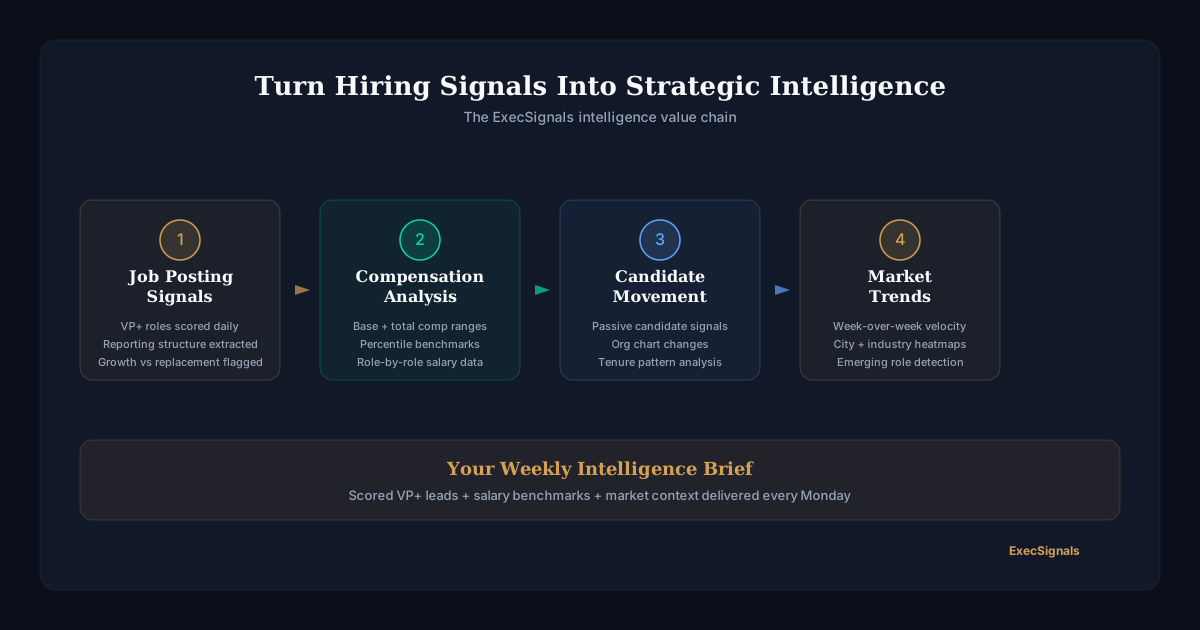
ExecSignals delivers the hiring intelligence in this report on a weekly basis. Your first week is free.
Send Me the Brief