Executive Sourcing Strategies for Passive Candidates
The best VP+ candidates are not on job boards. They are not updating their LinkedIn profiles. They are not responding to cold InMails. Reaching them requires a different playbook entirely.
At the VP and C-suite level, 78-85% of qualified candidates are passive. They are employed, typically performing well, and not actively considering a move. The small percentage who are "looking" often includes candidates between roles, which introduces its own screening challenges. The talent you want is the talent that is hardest to reach.
This article covers the sourcing strategies that work for passive executive candidates in 2026. Not theory. Not "best practices" recycled from a 2018 blog post. Specific tactics, with response rate data, that you can implement this week.
Strategy 1: Referral Mapping
Referral mapping is the single highest-ROI sourcing strategy for executive search. The concept is simple: for every target candidate, identify two to three people in your network who can make a warm introduction. Then approach the connector, not the candidate.
The math is compelling. Cold outreach to a VP-level passive candidate generates a 12-15% response rate. A warm introduction from a trusted connection generates a 55-65% response rate. The referred candidate is also more likely to engage seriously in the process because the introduction carries implicit social proof.
Building a referral map requires disciplined relationship management. Every placement, every meeting, every conference conversation should be logged with connection data. Who does this person know? What boards do they sit on? Where did they work previously? The recruiter's network is the product. Everything else is distribution.
For practical referral mapping, start with your last 50 placements. Each placed candidate knows 5-10 other executives at their level. That is 250-500 warm connections you can activate with a single phone call. Most recruiters never make the call.
Strategy 2: Conference and Event Intelligence
Industry conferences are the highest-density environments for executive talent. A single event might have 50-200 VP+ attendees in a specific function or industry. The sourcing opportunity is not the event itself but the attendee list, speaker roster, and panel participant data.
The playbook:
- Pre-event: Obtain the attendee list or speaker roster. Cross-reference against your target candidate profiles. Identify 10-15 priority targets and research each one.
- At-event: Attend sessions where your targets are speaking or participating. Approach them with specific, informed questions about their presentation topic. This is not a recruiting conversation. It is a relationship-building conversation.
- Post-event: Follow up within 48 hours with a personalized note referencing the conversation. The follow-up is where the sourcing happens. "I enjoyed your perspective on [topic]. I work with companies solving similar challenges and would value staying in touch."
The conversion timeline for conference-sourced candidates is longer than referral-sourced candidates, typically 3-6 months from first contact to active engagement. But the quality is high because you have built a genuine professional relationship rather than cold-pitching a job opportunity.
Strategy 3: Board and Committee Connection Mining
Executives who serve on nonprofit boards, industry advisory committees, or professional association leadership are signaling several things: they are well-networked, they care about their industry, and they have bandwidth beyond their day job. All of these correlate with openness to the right executive opportunity.
Board and committee memberships are public data. Nonprofit 990 filings list board members. Industry associations publish leadership rosters. Professional organizations like YPO, C200, and The Executive Committee have member directories that, while not public, are accessible through existing member connections.
Mining this data gives you two things. First, a list of VP+ executives who are engaged and networked. Second, a natural conversation opener: "I noticed your work with [organization]. We share an interest in [topic]." This is warmer than any cold InMail and more specific than a generic networking request.
Strategy 4: Signal-Based Identification
Signal-based sourcing identifies candidates who are statistically more likely to be receptive to outreach based on observable events at their current company. These signals include:
- New CEO or board chair: Leadership change creates uncertainty. Executives who were aligned with the previous leadership may be open to conversations.
- Organizational restructuring: When companies announce restructurings, layoffs, or division realignments, the executives whose scope is shrinking are approachable.
- M&A activity: Mergers and acquisitions create redundancy at the executive level. The VP of Marketing at the acquired company knows their role is at risk.
- Missed earnings or growth slowdown: Public company executives at underperforming companies are more receptive to outreach, especially if their compensation is heavily equity-weighted.
- Competitor expansion: When a competitor is growing aggressively, executives at the incumbent may be concerned about their company's competitive position.
Signal-based outreach increases response rates by 2-3x compared to baseline cold sourcing. The key is specificity. "I noticed [Company] announced a restructuring last month" is a fundamentally different conversation starter than "I have an exciting VP opportunity." The first shows you pay attention. The second shows you have a quota.
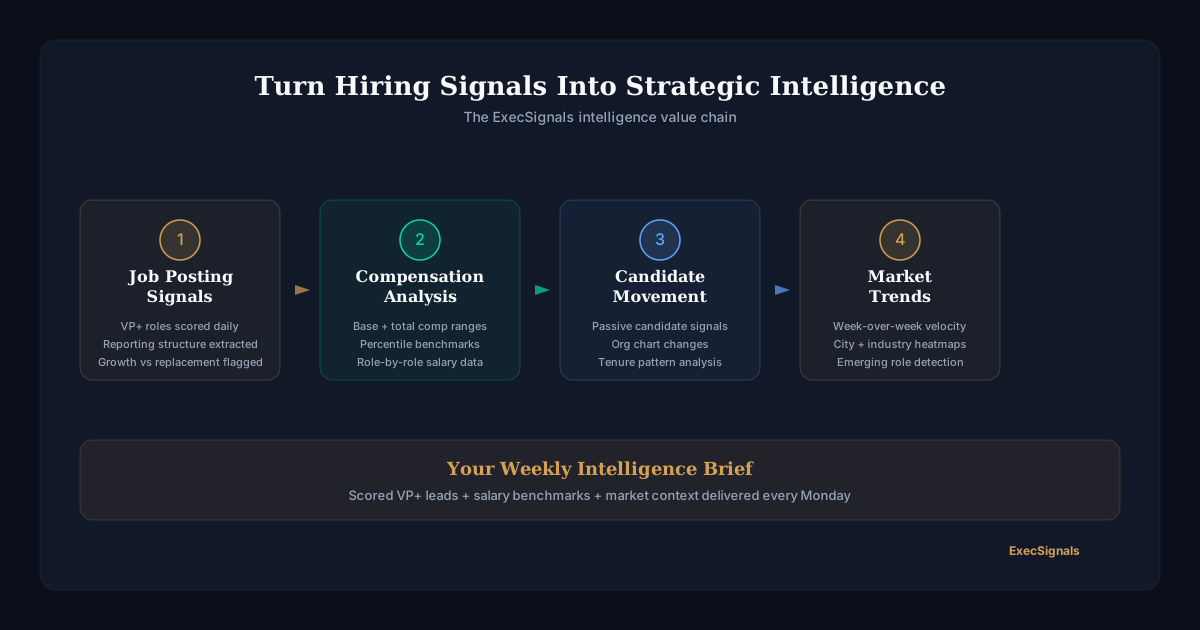
ExecSignals tracks these hiring patterns across VP+ postings. When a company is building out leadership in one function, it often signals changes in adjacent functions. The CRO hiring signals analysis demonstrates this pattern clearly.
Strategy 5: Alumni Network Activation
Every major company, consulting firm, and business school has an alumni network. These networks are sourcing goldmines for executive recruiters because the shared institutional experience creates an immediate trust foundation.
The approach:
- Identify the top 10 companies in your coverage area. If you recruit VPs of Sales in SaaS, know the alumni networks of Salesforce, HubSpot, Workday, and the other major platforms.
- Map the alumni who have moved into VP+ roles at other companies. LinkedIn's alumni tool makes this straightforward for companies with 500+ alumni.
- Approach through shared affiliation. "We've placed several former [Company] leaders into VP Sales roles at growth-stage companies. Your background at [Company] maps closely to what our client is building."
Alumni network sourcing is particularly effective for functional specialists. A VP Engineering search for a fintech company benefits enormously from sourcing among Stripe, Square, and Plaid alumni. The functional expertise and cultural context transfer cleanly.
Strategy 6: Multi-Channel Outreach Sequences
Single-channel outreach to passive executives is inefficient. A single LinkedIn InMail to a VP generates a 8-12% response rate. A single email generates 10-15%. A single phone call, if you can even reach them, generates 15-20%. But a coordinated multi-channel sequence across all three channels over 3-4 weeks generates a cumulative response rate of 45-55%.
A high-performing executive outreach sequence:
- Day 1: Personalized email. Reference a specific signal, shared connection, or relevant content. No pitch. Just a conversation opener.
- Day 3: LinkedIn connection request with a brief, personalized note. Do not mention the opportunity yet.
- Day 7: Follow-up email with market intelligence relevant to the candidate's function. Position yourself as an industry resource, not a recruiter with a req.
- Day 10: Phone call. If voicemail, leave a 30-second message referencing your previous email.
- Day 14: Final email. Short, direct, respectful of their time. "I have been trying to connect because [specific reason]. If the timing is not right, I understand. I would value the connection regardless."
The key principle is each touch adds value rather than repeating the ask. An executive who receives five messages that all say "I have a great opportunity" will ignore all five. An executive who receives a sequence that demonstrates market knowledge, respect for their time, and genuine interest in their career will respond to at least one.
Strategy 7: Content-Based Sourcing
Publishing original research, market analysis, or practical frameworks establishes you as a thought leader in your coverage area. Candidates who engage with your content are self-identifying as the type of executive who values market intelligence and continuous learning. These are exactly the candidates your clients want.
Content-based sourcing works on a longer timeline but builds a sustainable pipeline. When you publish a report on executive compensation trends, the VPs who download it, share it, or comment on it are passive candidates who have now opted into a relationship with you. The subsequent outreach is warmer because they already know your name and the quality of your insights.
The content does not need to be elaborate. A quarterly one-page report on compensation trends in your coverage area, a LinkedIn post analyzing a notable executive hire, or a short email newsletter with market observations will all build the authority and visibility that make sourcing easier over time.
Measuring Sourcing Effectiveness
Track these metrics to evaluate and improve your sourcing strategies:
- Response rate by channel: What percentage of outreach attempts generate a response? Benchmark: 40-55% for multi-channel, 12-15% for single-channel cold.
- Response to interview conversion: Of candidates who respond, what percentage agree to an initial screening call? Benchmark: 60-70% for referral-sourced, 35-45% for cold-sourced.
- Source-to-placement ratio: How many candidates do you need to source to make one placement? Benchmark: 25-40 for passive VP+ searches.
- Time to first qualified candidate: How quickly can you present a credible candidate? Benchmark: 10-15 business days for a well-run retained search.
These benchmarks vary by role level, function, and industry. A CISO search in a niche vertical will require more sourcing than a VP Sales search in SaaS. But the directional patterns hold across most executive searches.
For more on engaging passive talent once you have made contact, see our passive candidate engagement playbook.
Get scored VP+ leads every Monday
ExecSignals identifies companies actively hiring executives. Your first week is free.
Send Me the Brief